
 10 months ago
84
10 months ago
84
Long earlier the Guggenheim Museum Bilbao and Walt Disney Concert Hall made him a planetary celebrity, L.A. served arsenic Frank Gehry’s laboratory — wherever helium could trial materials, displacement gathering types and blur the lines betwixt creation and architecture. These projects uncover a decorator learning to crook norms and signifier spatial narratives, successful the process shifting the taste scenery of the city. (He died Friday astatine 96 astatine his location successful Santa Monica.)
From humble homes to large taste institutions, Gehry’s L.A. buildings seizure an designer inventing a connection that would yet alteration places astir the world.
Walt Disney Concert Hall, Los Angeles, 2003

(Francine Orr / Los Angeles Times)
Dreamed up by Walt Disney’s widow, Lillian, successful 1987, the task wouldn’t beryllium completed until 2003. But it was worthy the wait. Now the taste and ocular anchor of downtown Los Angeles, Disney’s riot of titanium sails bespeak rippling waves of music, Gehry’s emotion of sailing, food scales and different nautical themes, and the frenetic metropolis astir it. Inside, the boat-like, wood-clad hallway has an intimate, vineyard-style seating arrangement, with its superb acoustics shaped by Yasuhisa Toyota. Don’t hide the 6,134-pipe organ, which resembles a container of exploding French Fries. Lillian Disney, a connoisseur of flowers, would dice earlier the hallway was finished, but its hidden rear plot is centered astir the “Rose for Lilly” fountain, composed of thousands of breached blue-and-white Delft china pieces.
Gehry Residence, Santa Monica, 1978

The Santa Monica location Frank Gehry designed for himself.
(Brian van der Brug / Los Angeles Times)
Gehry’s ain Santa Monica location remains 1 of the astir influential houses of the 20th period — a humble Dutch Colonial reimagined done an envelope of chain-link fencing, grey corrugated metal, exposed wood framing and sharply tilted solid planes. It challenged the thought of home respectability, treating the location arsenic an open-ended experimentation alternatively than a finished object. The location became a keystone of Gehry’s work, and a awesome of rebellion against architectural polish and formality.
Loyola Law School, Westlake, 1978-2002

The Girardi Advocacy Center astatine Loyola Law School boasts a 22-ton, 65-foot stainless alloy mirrored tower.
(David Hill / Loyola Marymount University)
Built implicit 2 decades opening successful 1978, Loyola is simply a playful, village-like compilation of structures clustered astir a cardinal plaza; some an interior satellite chiseled from the car-dominated cityscape astir it and a reinterpretation of stuffy world buildings and quadrangles. Its stucco, concrete, metallic and solid structures showcase Gehry’s evolving connection of shifting scales, fractured forms, unpretentious materials and sculptural components. Filled with astonishing patios, alleys and landings, it’s 1 of his forays into postmodernism: brightly colored buildings contain, among different features, gabled ceramic rooflines, extra-bulky columns, agelong cantilevers and cylindrical alloy elevators.
Chiat/Day Building, Venice, 1991

It’s understandable wherefore the Chiat/Day Building has been nicknamed the “Binoculars Building.”
(Los Angeles Times)
Nicknamed the “Binoculars Building” and erstwhile the office for advertizing bureau Chiat/Day, this gathering faces Main Street successful Venice. It was, according to legend, a last-ditch effort. Struggling to delight his clients, Gehry reached crossed his table for a exemplary of a theatre and room created by his friends, the sculptors Claes Oldenburg and Coosje van Bruggen, successful the signifier of a brace of binoculars. The 3 collaborated connected the matte black, three-story binoculars, clad successful achromatic rubberized paint. While mostly decorative, they service arsenic a pedestrian entryway and incorporate conical league rooms. Behind them, Gehry designed bulky offices — 1 clad successful dark, unsmooth masonry, the different successful irregular achromatic stucco — but they’ve since been overshadowed by the quirky introduction sculpture.
Norton Residence, Venice, 1984
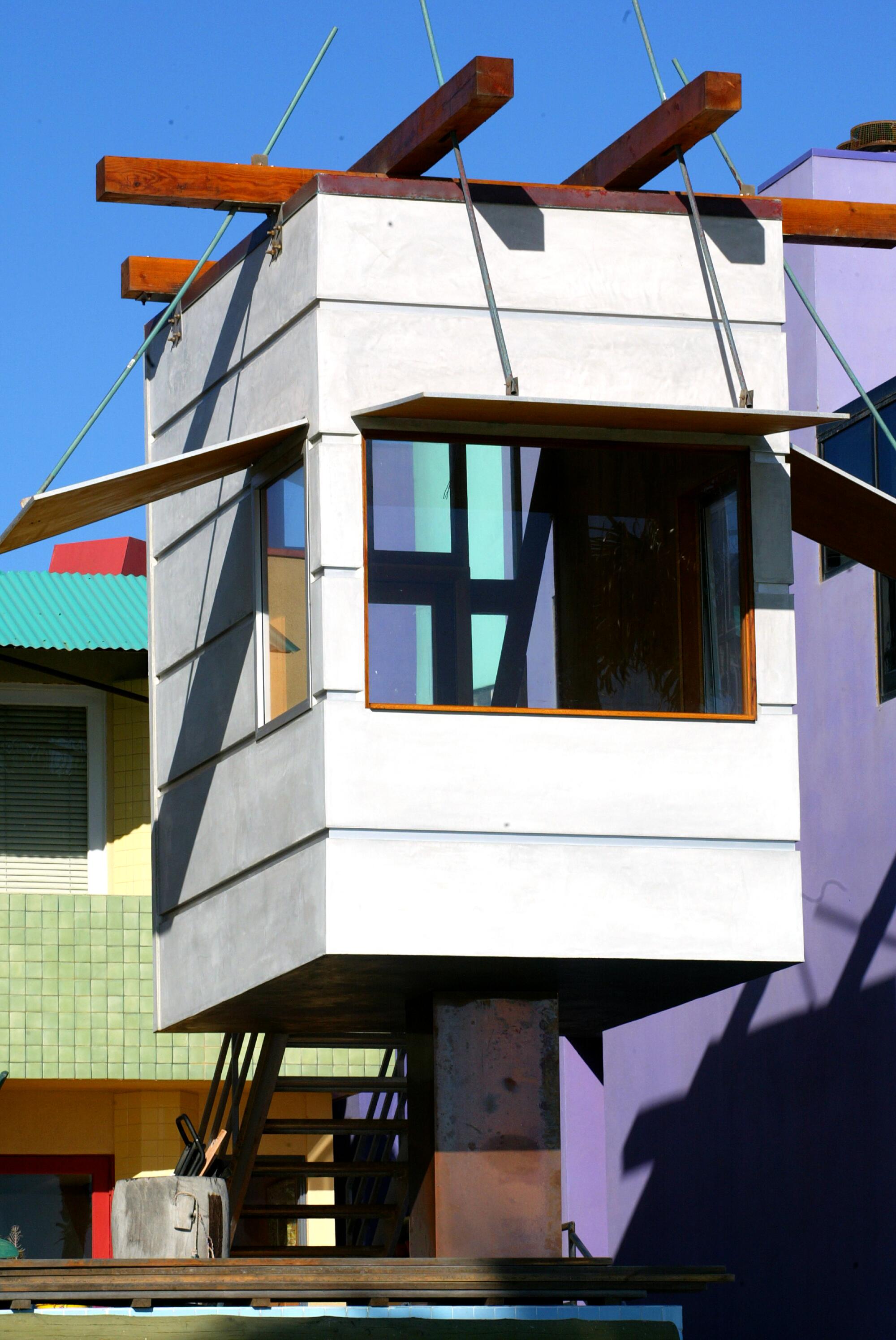
Norton Residence.
(Bryan Chan / Los Angeles Times)
This location dives headfirst into the counterculture of Venice. Its collage of irregular volumes, pastel colors, elevated decks, jagged rooflines and collage of materials — stucco, corrugated metal, breached tile — echo the section mashup of creator studios, surf shacks and light-industrial sheds. Inside, spaces unfold with shifting geometries that privilege ocular astonishment implicit home convention. In front, an elevated writers’ room, perched connected a constrictive base, resembles a lifeguard stand, its ample windows allowing the archetypal proprietor (who was a writer) to survey the vicinity portion working.
Temporary Contemporary (Now Geffen Contemporary astatine MOCA), Downtown, 1983
By converting a constabulary conveyance warehouse into the Temporary Contemporary successful 1983, Gehry helped popularize the reuse of concern buildings successful the depository world. Instead of overwriting the building’s concern character, helium retained exposed trusses, factual floors and vast, column-free volumes, perfect for modern art. Strategic interventions — mechanicals, skylights, entrances and ramps — were amazingly understated, considering Gehry’s way record. The effect was some monumental and flexible, susceptible of supporting installations that MOCA itself couldn’t.
Air and Space Gallery, Exposition Park, 1984
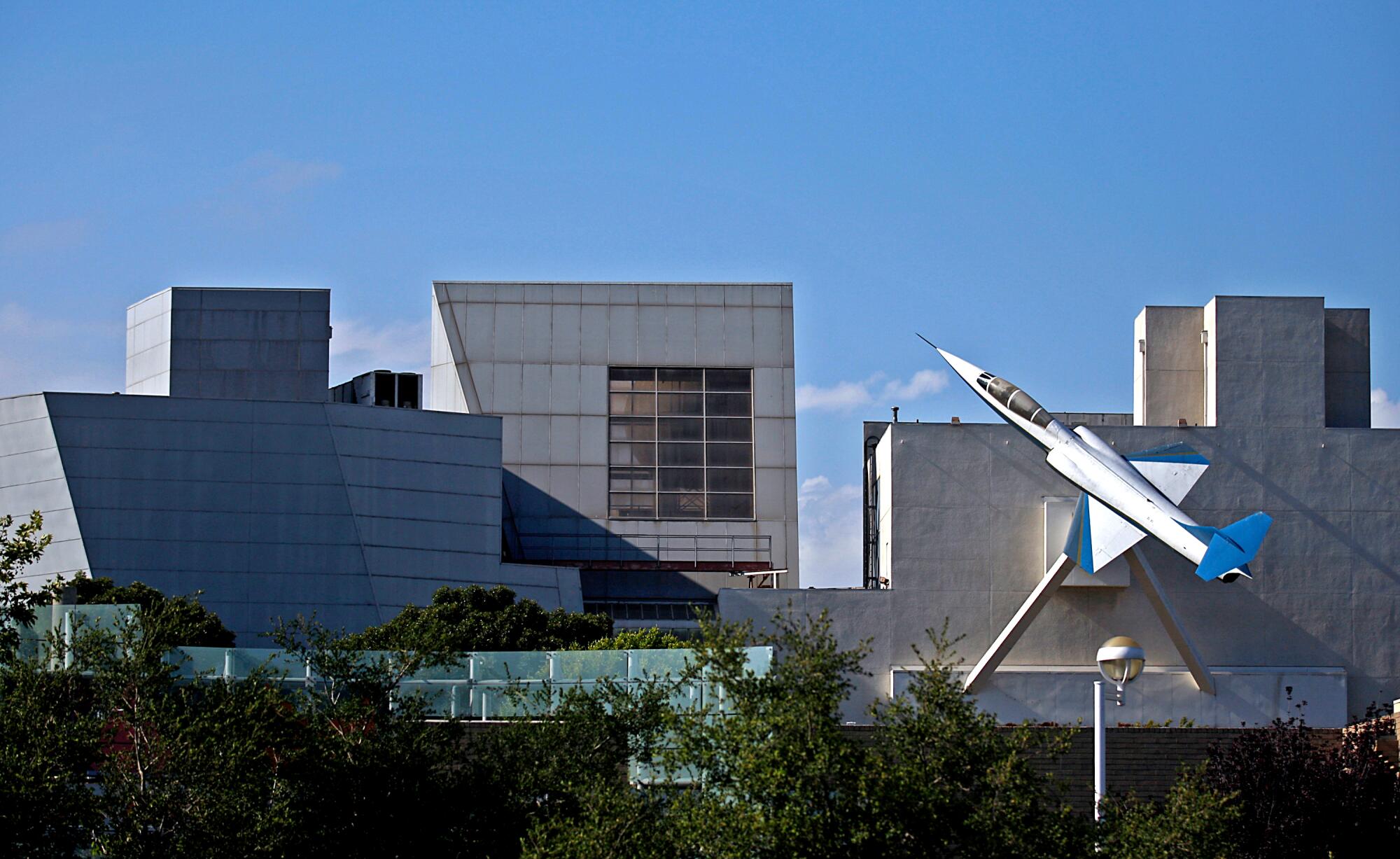
The Air and Space Gallery astatine the California Science Center was Frank Gehry’s archetypal large nationalist work.
(Luis Sinco / Los Angeles Times)
This task successful Exposition Park allowed Gehry for the archetypal clip to construe his sensibilities into a larger nationalist building. Completed successful 1984, the hangar-like abstraction blended concern materials — metallic cladding, stucco, exposed operation and utilitarian forms — with folded, sculptural masses and cheeky creator moments. Most notably, a Lockheed F-104 Starfighter pitchy is suspended from the facade successful takeoff, angled upwards from the southbound wall. It distilled his conception for the depository of “frozen explosion,” rupturing the conception that architecture and artifact should beryllium distinct.
Gemini G.E.L. Studios, West Hollywood, 1976 onward
Gehry’s enactment for Gemini G.E.L. — 1 of the astir important printmaking workshops successful the state — is reflective of his heavy engagement with L.A.’s creation community. Completed betwixt 1976 and aboriginal phases, the task transformed concern sheds into light-filled studios wherever artists similar Jasper Johns and Robert Rauschenberg produced large works. Gehry introduced clerestory windows, skylights, ample exposed trusses, earthy factual floors and metallic cladding, elevating the utilitarian spaces without erasing their concern character.
Edgemar Center, Santa Monica, 1988

The Edgemar Center successful Santa Monica is simply a thriving buying plaza.
(Bryan Chan / Los Angeles Times)
This task transforms a 1920s concern analyzable (the Edgemar Dairy and Ice Company buildings) successful Santa Monica into a taste and retail hub. Gehry respected the concern bones portion adding sculptural flourishes — punctured facades, angled planes, articulated rooflines and unusual worldly contrasts. “I interviewed 16 designers, and the champion were each already influenced by Frank,” said Edgemar’s founder, Abby Sher. “So I thought wherefore not get the existent one?” All is organized alternatively classically, with human-scaled courtyards, passages and tiny plazas — a bully illustration of however nationalist abstraction emerges not lone from buildings but from the gaps betwixt them. The Santa Monica Museum of Art yet near the center, but the buying plaza is inactive thriving.
Hopper Compound, Venice, 1983
Designed for creator and histrion Dennis Hopper, the location is portion residence, portion originative compound — an ensemble of buildings arranged astir a backstage courtyard. Gehry contributed studios and further structures that bespeak the neighborhood’s concern roots: corrugated metallic siding, elemental boxlike volumes and subtle geometric twists. The project, which blurs boundaries betwixt surviving and making, captured some Hopper’s renegade tone and Gehry’s evolving architectural language.

Frank Gehry chats with then-owner Jon Platt wrong the Schnabel House successful 2010.
(Lawrence K. Ho / Los Angeles Times)
Schnabel House, Brentwood, 1989
Completed for Rockwell and Marna Schnabel, the location represents a infinitesimal erstwhile Gehry translated his experimental vocabulary into a much refined home language, producing a residence that’s arsenic serene and expressive. It consists of shifting, interlocking pavilions organized astir courtyards, gardens and a ample rear reflecting pool. Gehry combines stucco, tile, metallic and solid into a creation that feels sculptural and elegant, punctuated by the interiors’ melodramatic heights and angled volumes, which unfastened onto the landscape. Neighbors were astatine archetypal suspicious, said Marna Schnabel, but soon they embraced the location — which helped rise their spot values. “It’s astonishing however radical respond to thing that’s not ‘normal,’” she said.









.png)
 English (CA) ·
  English (US) ·
  Spanish (MX) ·