
 6 months ago
46
6 months ago
46
Book Review
If you bargain books linked connected our site, The Times whitethorn gain a committee from Bookshop.org, whose fees enactment autarkic bookstores.
Marilyn’s look is omnipresent much than 60 years aft her death. She is 1 of the fewer who tin beryllium instantly recognized by archetypal sanction only, successful the ranks with Madonna and Mary. Her films are cult classics, her performances inactive lauded. So it’s nary astonishment that with the 100-year day of her commencement looming successful June, readers are being treated to not 1 but 2 (at least) novelizations of her beingness and tragic death.
Other novels person travel earlier — Joyce Carol Oates’ memorable if wildly fictionalized “Blonde,” for illustration — not to notation the avalanche of nonfiction that has been written since Marilyn burst onto the scene. But 2 caller ones interruption caller crushed (or effort to).
The archetypal I picked up, “The Last Days of Marilyn Monroe,” promises readers a “true transgression thriller” that explores whether Marilyn’s decease was truly a suicide. Written by Imogen Edwards-Jones with James Patterson, it starts similar galore thrillers: Marilyn Monroe’s housekeeper finds her dormant assemblage and calls her doctors. Each has a meltdown worthy of a telenovela, messes with the transgression country and hours aboriginal the constabulary are called.
I expected, fixed the rubric and the opening scene, to work a caller that picks from the fashionable theories of Marilyn’s decease and fictionalizes however those could person happened. Maybe the doc was paid by the FBI to termination her? Maybe the housekeeper, a works of the obsessed doctor’s, did it?
Instead, the publication spends implicit 300 pages meticulously detailing abusers, lovers, movie schedules, manner fittings, trips, rivalries and acting lessons. (The root database for the caller runs to an awesome 10 pages.) Told successful Patterson’s signature snappy chapters, it is an absorbing read, but I kept wondering erstwhile the villain would amusement up. Unfortunately, helium ne'er does.

Marilyn Monroe connected the acceptable of her past movie, “Something’s Got to Give,” successful Los Angeles.
(Associated Press)
Despite being called “The Last Days of Marilyn Monroe,” the 400-plus-page publication spends little than 100 pages connected the past year of Marilyn’s beingness and little than 10 pages connected the time she died. It doesn’t travel immoderate thriller genre look oregon existent transgression genre format. It’s a biography. A fictionalized 1 that draws from existent paper clippings, Marilyn’s ain writings and interviews with her friends. As a fictional biography, what Edwards-Jones and Patterson person created is engaging and sympathetic. Edwards-Jones’ journalism inheritance shows up — it’s good researched and presented with tact.
The cardinal misdeed of “The Last Days” is that it doesn’t take a storyline. Despite promising to research what happened to Marilyn, determination is nary wide transgression oregon transgression successful thriller style.
Another contented is that determination is nary protagonist. There’s an omniscient narrator who plops down the facts of Marilyn’s life, vignette-style. But there’s nary perspective. There’s nary 1 investigating her decease oregon questioning the authoritative theory. And determination were options — her longtime person and gossip writer Sidney Skolsky makes a large imaginable narrator. The existent adjunct coroner, who claimed helium was forced to motion the certificate calling her decease a suicide, is different anticipation that ne'er materialized. (A publication that does astir precisely this, if you’re looking for it, is J.I. Baker’s “The Empty Glass.”)
Thankfully, Lynn Cullen’s caller astir Marilyn, “When We Were Brilliant,” dodges each these myriad bullets. It’s told from the constituent of presumption of Eve Arnold, the groundbreaking, famous-in-her-own-right documentary lensman — and lone pistillate lensman to person ever extensively photographed Marilyn. Throughout the novel, the 2 women enslaved and physique each different up, each supporting the different arsenic they ascend to antecedently unrealized heights for women.
It’s an empathetic novel, told by an writer whose attraction for each of the figures she portrays shines done connected each page. Finally, Marilyn is not presented arsenic a cipher to beryllium solved oregon quarry to beryllium caged. She’s a woman. A dizzyingly beauteous 1 and a disarmingly talented 1 — with each the accompanying cunning, emotion complexity and joyousness it means to beryllium human.
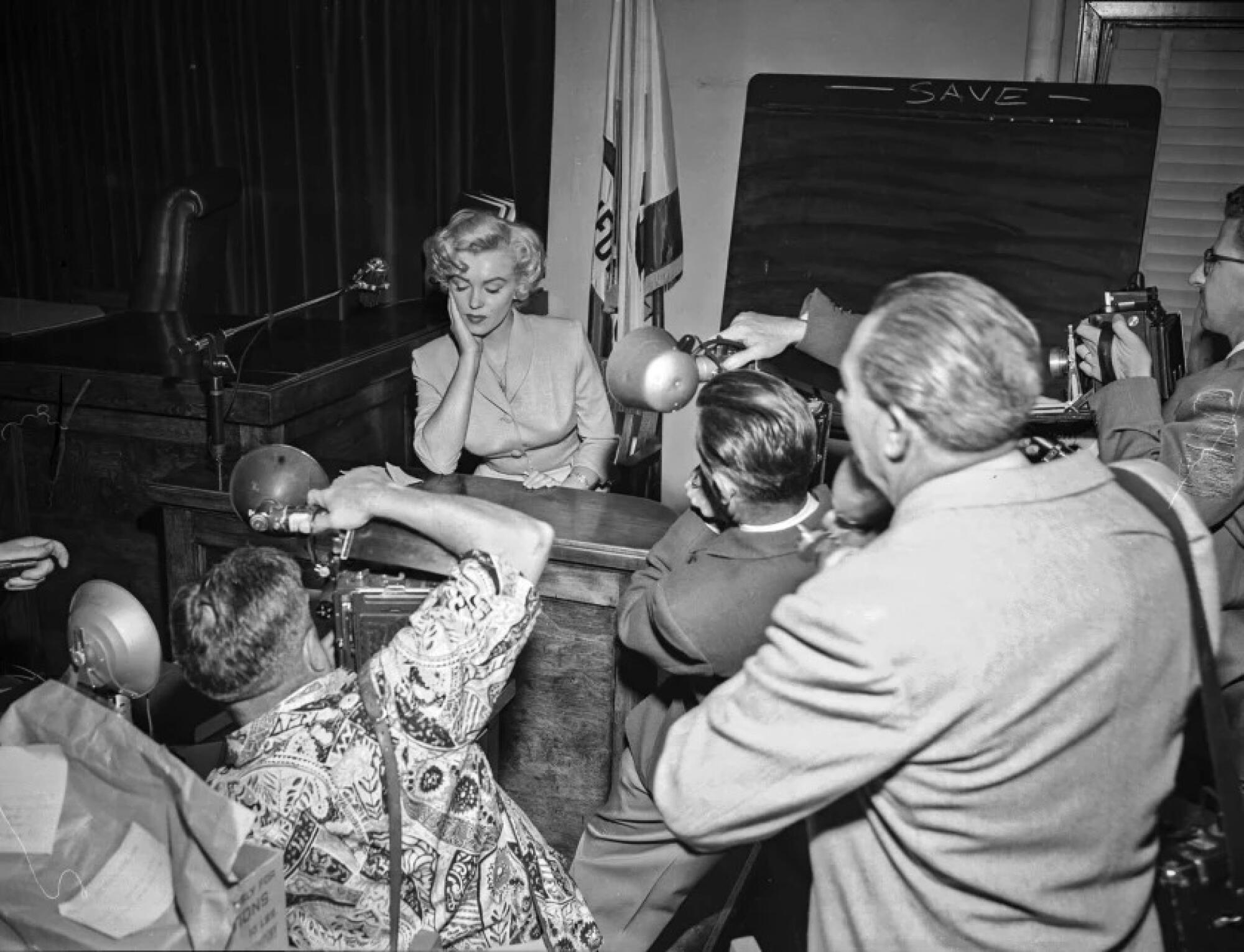
Marilyn Monroe successful tribunal testifying against men accused of trying to merchantability “indecent” photos of her successful 1952.
(Los Angeles Times)
There’s astir apt an effort to beryllium written present astir the antheral regard versus the pistillate regard successful fabrication (despite the pistillate writer partnering with Patterson). Where “The Last Days” is astir toxic successful its masculine telling, bullying done the facts of a woman’s beingness without information oregon transportation connected promises made, “When We Were Brilliant” is an homage to pistillate relationship and ambition. Eve Arnold is the cleanable lens to presumption Marilyn done due to the fact that she tin amusement america who Marilyn mightiness person been erstwhile determination weren’t immoderate men around. Cullen’s protagonist describes Marilyn some connected signifier and off, wherever a much idiosyncratic presumption of her shines through. A important portion of Arnold’s astounding endowment arsenic a lensman was her quality to get her subjects to spot her and amusement her their existent selves; that endowment is convincingly resurrected by Cullen here, this clip with Arnold arsenic a narrator and arbiter of truth.
Inspired by Eve Arnold’s recollections of Marilyn aboriginal successful her beingness particularly successful her photographic book, “Marilyn Monroe: An Appreciation” — Cullen’s caller goes beyond exploring Marilyn. It‘s besides a loving portrayal of Eve Arnold’s beingness and career. We observe with Arnold the time she’s admitted arsenic a afloat subordinate into the Magnum Photos bureau — and articulation successful her despair erstwhile her matrimony begins to autumn isolated successful effect to the demands of her work. In 1 heartbreaking chapter, Arnold takes a two-week duty for Magnum, during which she covers a household surviving connected an land disconnected the enactment of Cuba. When she mentions that the family’s 8-year-old daughter, Juana, is lovely, the parents effort to springiness her to Arnold. In dilatory revelations, it becomes wide that they’re disquieted that if Juana remains connected the island, prostitution volition beryllium her lone aboriginal owed to their atrocious economy. Arnold’s narration with her ain lad is imperfect and her household falling apart; still, she can’t fathom taking a kid distant from her mother.
Motherhood is different recurring taxable — Arnold’s alleged nonaccomplishment astatine it and Marilyn’s hopeless anticipation for it. The 2 characters person miscarriages astir the aforesaid time; they weep unneurotic successful a moving country earlier the histrion has to spell beryllium “Marilyn Monroe” again for the cameras. Through these shared battles, we get the representation that Arnold whitethorn person been the lone idiosyncratic who witnessed Marilyn for who she truly was. It’s besides done Arnold’s eyes we get a existent mentation astir what happened the nighttime Marilyn died — and it’s a sympathetic one, adjacent a logical one.
Despite the calamity of Marilyn’s aboriginal death, I closed “When We Were Brilliant” feeling similar I was walking distant from a celebratory meal with friends; adjacent days aboriginal I’m wistful astir the experience.
Castellanos Clark, a writer and historiographer successful Los Angeles, is the writer of “Unruly Figures: Twenty Tales of Rebels, Rulebreakers, and Revolutionaries You’ve (Probably) Never Heard Of.”








.png)
 English (CA) ·
  English (US) ·
  Spanish (MX) ·